TFT vs OLED: Which Display Module for Your Product?
Lifetime of 20K–70K hours versus organic material aging, contrast of 800:1 versus 10,000:1, temperature range and total cost — the engineering trade-offs that decide whether your product ships with a backlit LCD or a self-emissive OLED module.
Two technologies, one product decision
The global OLED module export market reached USD 44.1 billion in 2024, up 50% year on year (FreightAmigo) — yet that growth does not make OLED the right choice for every product. TFT vs OLED is decided by five numbers: lifetime, contrast, temperature range, power and cost, measured against your size band and duty cycle.
This guide walks those five numbers in order, then closes with a decision matrix your procurement team can quote from directly. Neither technology is objectively better — each wins inside a specific envelope.
- TFT-LCD — LED backlight plus liquid crystal; 0.96"–15.6" standard range, IPS/TN variants, 300–1,000 nits.
- OLED — self-emissive organic pixels; PMOLED 0.42"–2.8" and round AMOLED to 5.5" with true blacks.
How LCD and OLED light their pixels
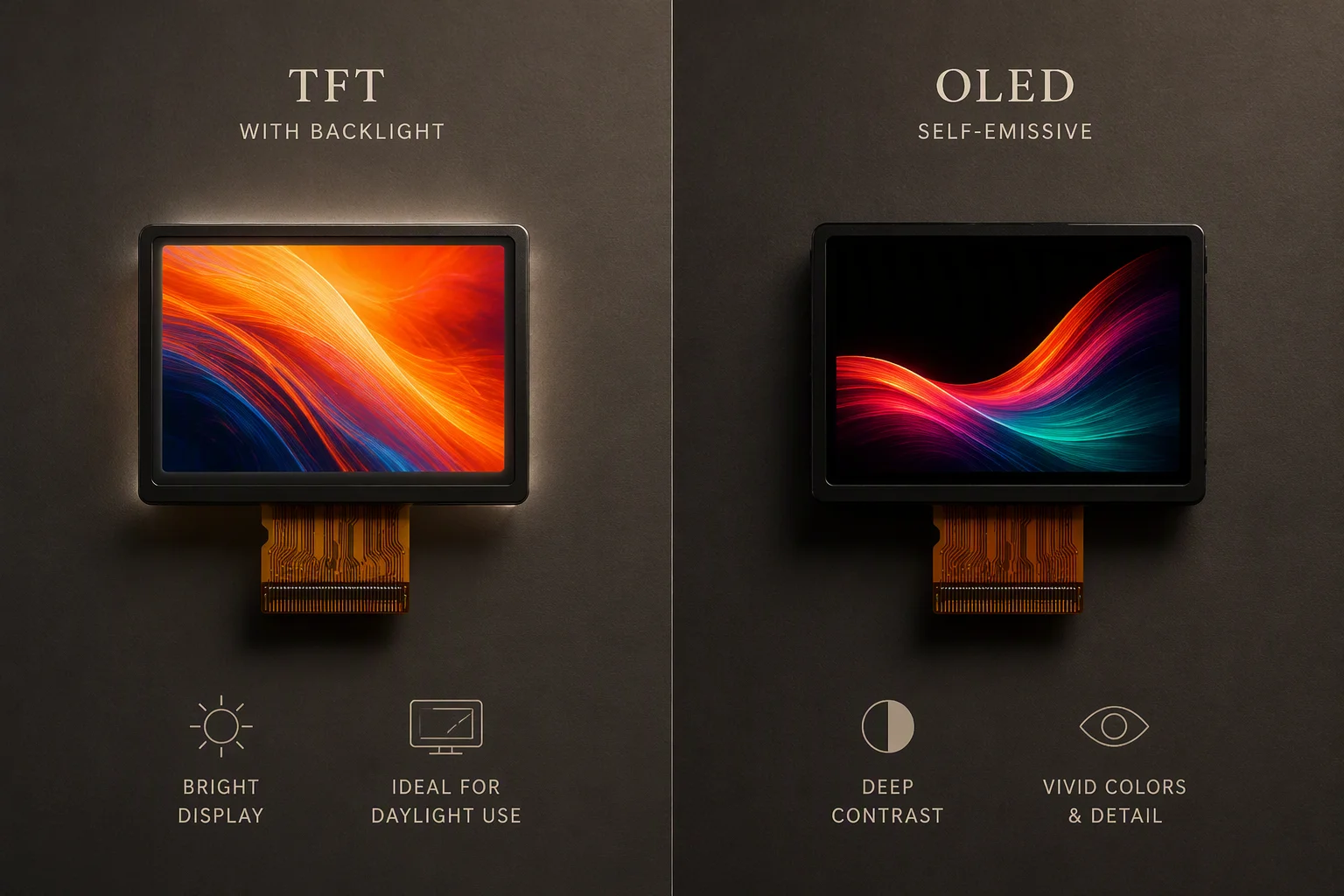
An LCD module is a laminated stack: LED backlight, light guide, polarizers and a liquid-crystal layer that rotates light per pixel. Because it needs a backlight, a TFT module is thicker and draws current continuously — but the backlight is also a replaceable, well-understood component with a documented life.
An OLED module generates light inside each pixel from organic compounds that emit when current passes. No backlight means thinner construction and per-pixel light control, but the organic emitters age — blue subpixels fastest — which caps brightness over the module's working life.
Brightness tells the story in numbers: standard TFT modules run 300–1,000 nits with high-brightness variants to 5,000 nits, PMOLED sits at 80–120 nits (enough for small dark-room icons), and AMOLED delivers 300–800 nits for wearables.
Lifetime and reliability under real duty
The most common rejection reason we hear from designers is: "OLED looks better, but will it last?" The honest answer depends on where you measure — backlight hours for LCD, emitter degradation for OLED. The table below compares both technologies on the numbers that survive a procurement review.
| Property | TFT-LCD (IPS) | OLED |
|---|---|---|
| Light source life | LED backlight 20K–70K h | Organic material aging; ~10K–30K h PMOLED, blue-subpixel decay in AMOLED |
| Contrast ratio | 800:1 (IPS panel) | >10,000:1 — pixels switch fully off |
| Temperature range | -40~+85°C industrial grades | -20~+70°C typical; material-limited below and above |
| Relative cost (same size) | 1× baseline | 2–3× for equivalent module |
| Static power | Backlight always on, mA-level draw | µA-level static draw (PMOLED segmented) |
| Response time (typ.) | 15–25 ms (IPS) | <1 ms per pixel |
| Viewing angle | 80/80/80/80° (IPS) | ~180° full viewing, no off-axis shift |
| Burn-in / image retention | None — uniform backlight | Risk — static images accelerate emitter aging |
Contrast, color and power: where OLED pulls ahead
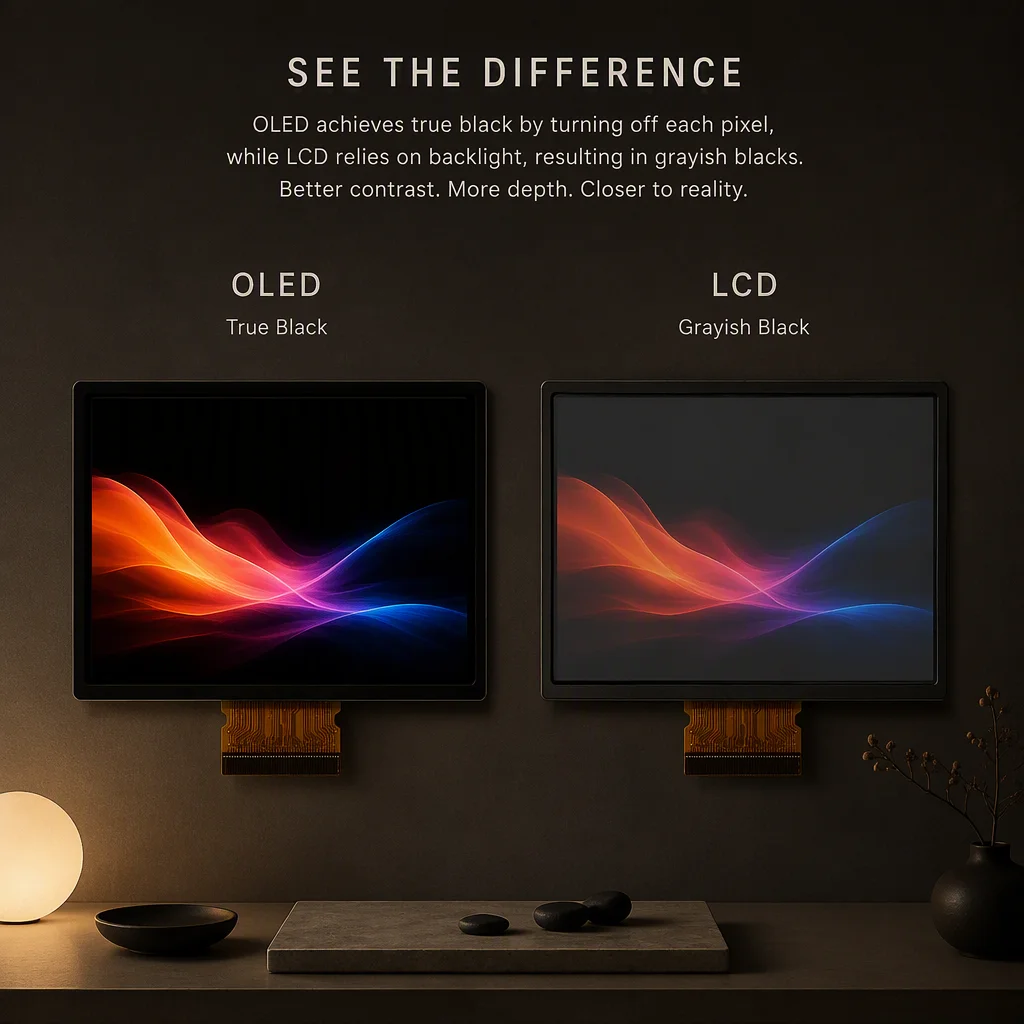
An IPS panel holds an 800:1 contrast ratio with a backlight that never fully dims, so blacks read as dark grey in a dark room. OLED pixels switch completely off, producing true black and an effective contrast above 10,000:1 — the reason dark UIs, watch faces and low-light medical interfaces look dramatically better on OLED.
Power reverses the familiar story in the small-size band: a segmented PMOLED drawing µA in static display mode outlasts a TFT whose backlight consumes continuously. That is why TWS charging cases and battery instruments pair naturally with PMOLED — static power is effectively zero.
The trade-off is sunlight. OLED brightness tops out at 300–800 nits on AMOLED, while high-brightness TFT reaches 1,000–5,000 nits with direct-LED backlights — so outdoor-readable products stay on the LCD side of the ledger.
Cost and sourcing: the procurement view
At equal size and resolution, an OLED module costs roughly 2–3× a TFT module. The premium buys the emitter stack and the yield challenge — organic deposition is harder to manufacture at scale than a backlight sandwich, and AMOLED supply is concentrated among a handful of panel makers.
Lead times and minimums also differ. Our standard TFT program quotes within 48 hours with an MOQ of 500 pcs, samples in 7–15 days and mass production in 20–35 days; custom OLED small sizes follow the same 8-step program, but large-format AMOLED runs are quoted against panel allocation.
Longevity is a sourcing decision too: our custom TFT LCM program locks glass and driver behind a 10-year supply guarantee with EOL warnings 12 months ahead, which matters when OLED emitter aging shortens the practical life of always-on displays.
Which module for which product
Size is the fastest filter: OLED wins the sub-1" band, TFT wins the industrial and outdoor bands, and the middle belongs to wearables and cost-sensitive instruments.
- Under 1" — OLED wins: µA static draw, no backlight, thin enough for TWS cases.
- 1"–3" wearables — AMOLED round displays, 1.2" 390×390 and 1.39" 454×454.
- 3.5"–7" HMI — TFT IPS: -40~+85°C, 50K–70K h backlight, 10-year supply.
- 7"–15.6" — TFT LVDS/eDP: cost and supply predictability win.
- Outdoor — high-brightness TFT at 1,000–5,000 nits with IP65 sealing.
| Product profile | Recommended | Why |
|---|---|---|
| Battery wearable under 1" | OLED (PMOLED) | µA static draw, thin stack, no backlight |
| Smartwatch 1.2"–1.4" | AMOLED round | True blacks, 300–800 nits, round cut |
| Industrial HMI 4.3"–10.1" | TFT IPS | -40~+85°C, 50K–70K h backlight, 10-yr supply |
| Medical monitor 7"–15.6" | TFT IPS | 800:1 color consistency, IEC 60601-1 files |
| Outdoor kiosk 10.1"–21.5" | High-bright TFT | 1,000–5,000 nits, IP65-ready front |
| Cost-driven instrument | TFT TN | Lowest cost, straight-on viewing duty |
| Always-on status display | OLED (PMOLED) | Static µA draw beats continuous backlight |
Take the next step from this article
Continue with the module pages behind each technology, or read the companion guide on IPS versus TN panels inside the TFT family.
TFT-LCD Modules
0.96"–15.6", IPS/TN, 800:1 contrast, MIPI/RGB/SPI/LVDS/eDP interfaces.
300–1,000 nits ExploreOLED & AMOLED
PMOLED 0.42"–2.8", round AMOLED 1.2" and 1.39" with µA standby.
SPI · MIPI · QSPI ExploreNext: IPS vs TN
Viewing angles of 80° versus 70/50° and 800:1 versus 500:1 contrast inside the TFT family.
Angle · 80° vs 70/50° Read GuideCustom LCM & ODM
2nd-cut shapes, bar and round formats, 8-step program with a 10-year supply option.
MOQ from 500 ExploreSend the size and the interface. We'll return a spec, a price and a schedule.
MOQ 500 pcs, samples in 7–15 days, mass production in 20–35 days. FOB Shenzhen, CIF or DDP, payment by T/T 30/70 or L/C — quoted within 48 hours.