Display design guides for engineers who ship products
TN vs IPS, brightness grading, interfaces, temperature grades, touch and lamination — eight guides written by the same engineers who build your modules, so the spec you approve is the module you receive.
Five decisions, in the order that matters
Every display program starts the same way. Work these five steps in sequence and you will land on a module that is mechanically, electrically and optically right the first time — no redraws, no requalification.
- 1 · Size and shape — start from the mechanical envelope: 0.96"–15.6" standard, custom 2nd-cut for bars and rounds.
- 2 · Panel technology — IPS for multi-angle viewing, TN for cost-driven straight-on designs, VA for premium large-format.
- 3 · Brightness — 300 nits indoors, 800 nits in semi-outdoor niches, 1,000 nits and above in direct sun.
- 4 · Interface — match the pipe to your SoC: SPI/RGB/MCU up to 5", MIPI for 4.3"–7", LVDS or eDP for 7"–15.6".
- 5 · Temperature grade — -20°C commercial, -30°C industrial, -40~+85°C automotive with AEC-Q100 parts.
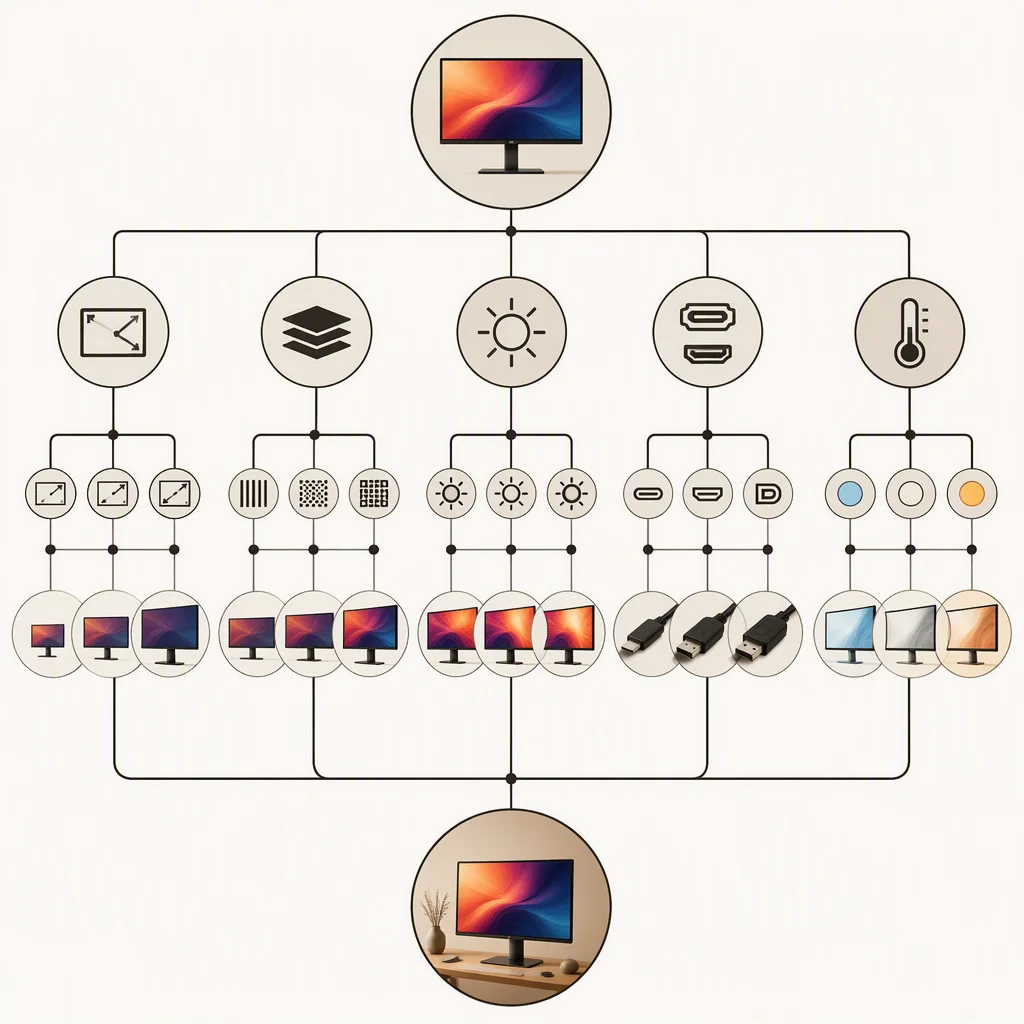
Follow the tree, skip the dead ends
This is the decision tree our engineers run in every pre-sales review. Start at the size, and each branch narrows the module until one part number remains — panel, brightness, interface, temperature, touch, lamination.
Eight decisions that decide the whole module
Each guide below covers one engineering decision with the numbers behind it — what changes, when to move up a grade, and where the extra cost buys real value.
TN vs IPS vs VA
IPS holds 80/80/80/80° angles and 800:1 contrast; TN trades to 70/70/50/70° and 500:1 at lower cost; VA reaches 3,000:1 for premium formats.
Read GuideBrightness Grading
300 nits indoor, 800 nits semi-outdoor, 1,000+ nits in direct sun — with AR coating and thermal design becoming mandatory above 1,500 nits.
Read GuideInterface Selection
SPI up to 2.4", RGB/MCU to 3.5", MIPI DSI 1/2/4-lane for 4.3"–7", LVDS and eDP 1.3/1.4 for 7"–15.6" panels with long FPC runs.
Read GuideTemperature Grade
Three grades: -20~+70°C commercial, -30~+80°C industrial, -40~+85°C automotive with AEC-Q100 qualified components.
Read GuideTouch Selection
RTP for cost-driven panels, PCAP 10-point with glove mode for modern UX — cover-glass chemistry matched to the operating environment.
Read GuideLamination Process
Air gap saves cost; OCA full lamination cuts reflections, adds impact strength and seals dust — effectively mandatory above 1,000 nits.
Read GuideEOL Management
Standard panels end-of-life in 3–7 years. A 10-year supply guarantee with 12-month EOL warnings keeps your production line alive.
Read GuideEMC & Certification
CE, FCC and RoHS/REACH declarations ship with every order; IATF 16949 and ISO 13485 stacks support regulated programs.
Read GuideThe selection cheat sheet, taped to your monitor
Eleven decision points with the primary choice, the alternative and the rule of thumb behind each one. Use it to fill in the spec sheet before you write a single email.
| Decision | Primary choice | Alternative | Rule of thumb |
|---|---|---|---|
| Panel size | 10.1"–15.6" HMI formats | 0.96"–3.5" embedded | Stay on stocked glass; 2nd-cut for bars and rounds |
| Panel technology | IPS | TN, VA | IPS for multi-angle; TN below cost targets; VA for premium |
| Viewing angle | IPS 80/80/80/80° | TN 70/70/50/70° | Operators off-axis? Use IPS |
| Contrast ratio | IPS 800:1 | VA 3,000:1 | Contrast matters in dim rooms and night shifts |
| Resolution | 1280×800 at 10.1" | 1920×1080 at 15.6" | Match UI density; do not over-resolve |
| Brightness | 300 nits indoor | 800 nits semi-outdoor | 1,000+ nits for direct sun; add AR above 1,500 |
| Interface | MIPI / RGB / SPI | LVDS / eDP | ≤5" MIPI or SPI; ≥7" LVDS or eDP |
| Temperature | -20~+70°C commercial | -30~+80°C industrial | -40~+85°C automotive with AEC-Q100 |
| Touch | PCAP 10-point | RTP | Gloved, wet or vandal-prone environments: PCAP |
| Lamination | OCA full lamination | Air gap | Sunlight or vibration: full lamination seals the stack |
| Supply horizon | 10-year locked program | Standard 3–7 yr panel EOL | Regulated products: lock glass and driver roadmap |
Four questions every design review hits
Short answers to the decisions above. Anything deeper — send your drawing and requirements, and an engineer walks through the tree with you.
Send your application — we'll return the recommended module and the reason.
Size, environment, viewing distance and volume. An engineer runs the selection tree with you and returns a spec, a price and a schedule within 48 hours, FOB Shenzhen.