IPS vs TN Panels: Viewing Angle & Color Guide
IPS vs TN is a viewing-angle and color decision first: 80/80/80/80° versus 70/70/50/70°, 800:1 versus 500:1 contrast, color consistency and a 10–20% cost difference — how to choose for HMI, medical and consumer products.
Two LCD families that look identical from the front
IPS and TN are both TFT-LCD technologies — same backlight, same drivers, same interfaces — and their modules look identical when viewed straight on. The difference appears the moment the operator stands at an angle: an IPS panel keeps its color, a TN panel washes out. IPS has grown to the majority share of new TFT-LCD designs in the 3.5"–15.6" band, while TN retains the cost-led entry tier.
Both families run the same 300–400 nits brightness grades and the same MIPI, RGB, SPI and LVDS interfaces, so the choice is not about electrical fit — it is about who looks at the screen, from where, and for how long.
- IPS — in-plane switching; 80/80/80/80° full angles, 800:1 contrast, stable color off-axis.
- TN — twisted nematic; 70/70/50/70° angles, 500:1 contrast, fastest response, lowest cost.
How IPS and TN arrange their pixels
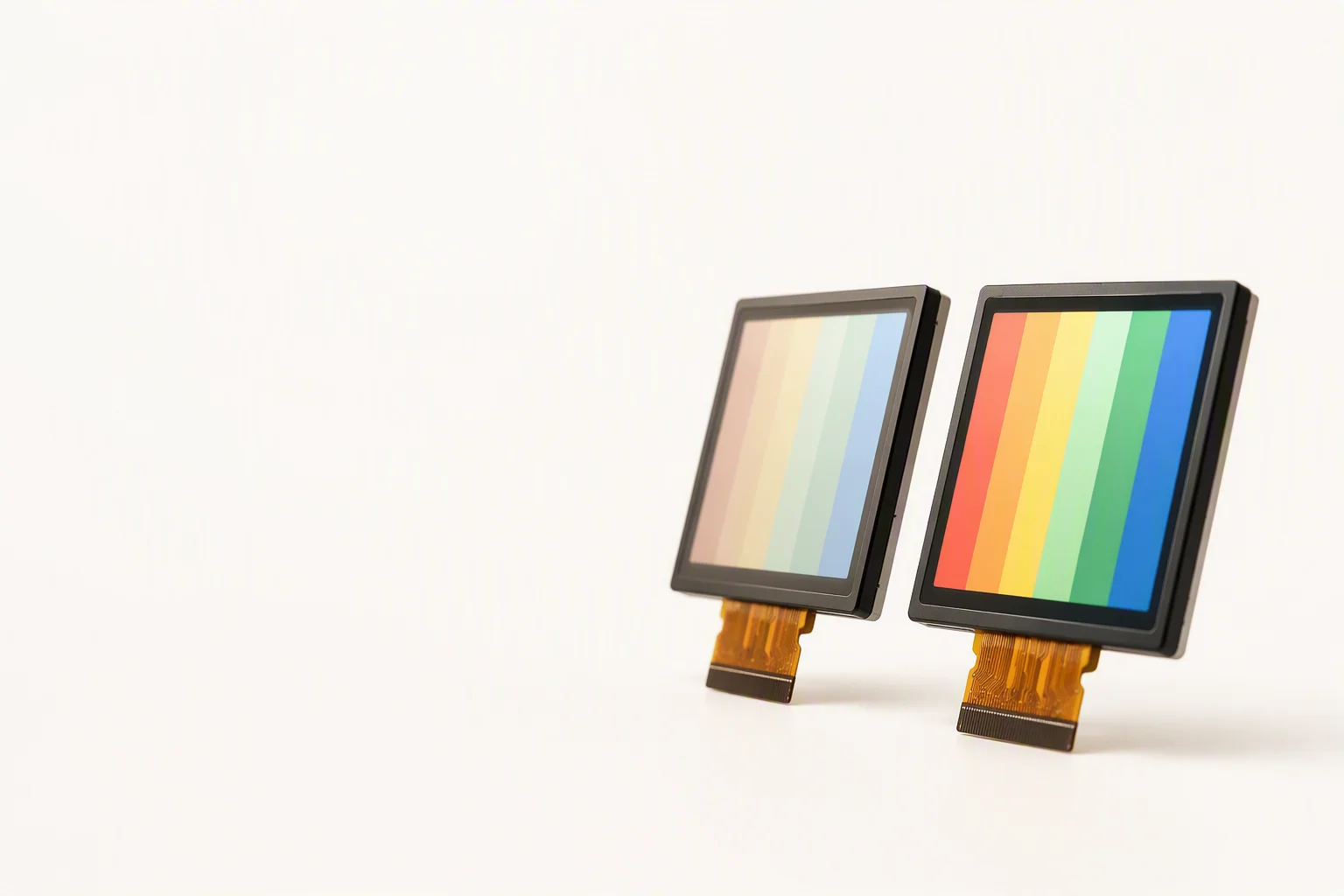
In a TN panel the liquid-crystal molecules twist 90° between the two substrates, which lets light pass in the on-state. Twisting is cheap to manufacture and fast to switch — typical response is 5–10 ms — but the molecules only align cleanly when viewed straight on, which is why TN angles collapse to 70/70/50/70° and colors shift toward yellow or invert at steep angles.
In an IPS panel the crystals rotate in-plane, parallel to the glass, so every subpixel presents the same aperture regardless of viewing direction. The result is 80/80/80/80° full viewing angles and stable color — at the cost of a slightly slower 15–25 ms response and a 10–20% higher panel price.
Color depth follows the same split: TN panels are typically 6-bit (262K colors), while IPS reaches 6–8-bit with 16.7M colors — the difference that matters in medical and design-review applications.
Viewing angle: 80° versus 70/50°
Viewing angle is quoted as four numbers — left, right, up, down — at which contrast falls below 10:1. An IPS panel holds 80/80/80/80°; a TN panel holds 70/70/50/70°, with vertical angle the weakest axis. In practice that means a TN screen mounted above eye level, or read by operators standing off to the side, visibly darkens.
| Property | IPS | TN |
|---|---|---|
| Viewing angle (H/V) | 80/80/80/80° full | 70/70/50/70° — vertical axis weakest |
| Contrast ratio | 800:1 | 500:1 |
| Color consistency off-axis | Stable, minimal shift | Yellow shift, inversion at steep angles |
| Response time (typ.) | 15–25 ms | 5–10 ms — faster |
| Color depth | 6–8-bit / 16.7M | 6-bit / 262K |
| Brightness (standard) | 300–400 nits | 300–400 nits — equal |
| Relative cost | Mid — baseline | 10–20% lower |
| Best fit | Multi-angle HMI, medical, color-critical | Straight-on, cost-driven instruments |
Contrast and color consistency
Contrast splits 800:1 on IPS versus 500:1 on TN — a real but modest difference in a lit factory hall, and a decisive one in dark rooms where grey blacks on TN become obvious against IPS.
Color consistency is where IPS earns its place in regulated products. Medical monitors and design-review stations need the same hue at the center and the edge of the panel, hour after hour; a TN panel shifts yellow when tilted and inverts at steep angles, which on a patient monitor is a safety-relevant difference.
- Medical displays — IPS 80/80/80/80° so a bedside value is never angle-dependent.
- Color proofing — IPS 16.7M colors with stable off-axis hue for design review.
- Cost-led instruments — TN where operators read straight on and budget rules.
Response time and cost: where TN still wins
A TN panel switches in 5–10 ms versus 15–25 ms for IPS — the reason high-refresh consumer displays and simple status screens still choose TN. In industrial HMI duty the difference is rarely visible: an operator setting a temperature reads values slower than either panel can refresh.
Cost is the second TN advantage: 10–20% lower module price at equal size and brightness. For a volume product shipping 100,000 units a year, that is a real line-item saving — provided the viewing geometry suits a straight-on screen.
The engineering rule we quote: if any human reads the display from more than 30° off-axis, or if the product carries a color or safety claim, choose IPS. If the display is a fixed, straight-on instrument readout, TN saves money with no visible penalty.
Which panel for which product
Brightness grades (300–400 nits) and interfaces are identical between IPS and TN, so the table below is purely about viewing geometry, color duty and budget.
| Application | Panel | Why |
|---|---|---|
| Low-cost multimeter / counter | TN | Straight-on readout, 10–20% cheaper |
| POS terminal (angled users) | IPS | Staff read from varied angles all day |
| Patient monitor | IPS | Angle-independent values, safety critical |
| Home appliance 2.8"–7" | TN or IPS | Budget vs kitchen viewing-angle trade-off |
| Color design review | IPS | 16.7M colors, stable off-axis hue |
| High-refresh consumer screen | TN | 5–10 ms response wins on motion |
| Outdoor kiosk | IPS high-bright | 1,000+ nits with wide-angle viewing |
Take the next step from this article
Both panels ship from our TFT line. Continue to the module page, or compare TFT against OLED for the other side of the technology decision.
TFT-LCD Modules
0.96"–15.6", IPS/TN panels, 300–1,000 nits, MIPI/RGB/SPI/LVDS/eDP.
800:1 IPS ExploreHigh-Brightness
500–5,000 nits sunlight-readable variants of the same IPS/TN line.
IP65 ready ExploreRead: TFT vs OLED
20K–70K h backlight versus OLED material aging, 800:1 versus 10,000:1.
Lifetime · 20K–70K h Read GuideCustom LCM & ODM
2nd-cut shapes, bar and round formats, 8-step program, MOQ from 500 pcs.
10-yr supply option ExploreSend the size and the viewing geometry. We'll pick the panel with you.
MOQ 500 pcs, samples in 7–15 days, mass production in 20–35 days. IPS and TN quoted side by side within 48 hours, FOB Shenzhen, CIF or DDP.