How to Build a Sunlight-Readable Display
Sunlight-readable display design is a four-part engineering budget: brightness from 1,000 to 5,000 nits, OCA optical bonding, AR coating, thermal management and IP65 sealing — an engineering guide for outdoor products.
"Bright enough" is a threshold, not a number
A display is sunlight-readable when its emitted light beats the light bouncing off its own glass. The industry thresholds, per the RisingLCD 2025 guide, are 1,000–1,500 nits for basic outdoor use, 2,500–3,500 nits for true readability in direct noon sun, and up to 5,000 nits for extreme all-weather signage above 21.5".
Reflectivity is the hidden variable: a 1,000-nit screen reflecting 13% of ambient light loses to a 700-nit screen reflecting 1%. That is why this guide covers brightness engineering, the optical stack, thermal design and the enclosure together — not as separate options.
- Brightness — direct-LED backlight arrays for 3,000–5,000 nits; edge-lit tops out lower.
- Optics — OCA full lamination cuts reflection from 13–15% to ~1–4%; AR coating tames glare.
- Thermal & sealing — aluminum-frame heat path, surface ≤45°C, IP65/IP66 front.
Feeding the pixels enough light
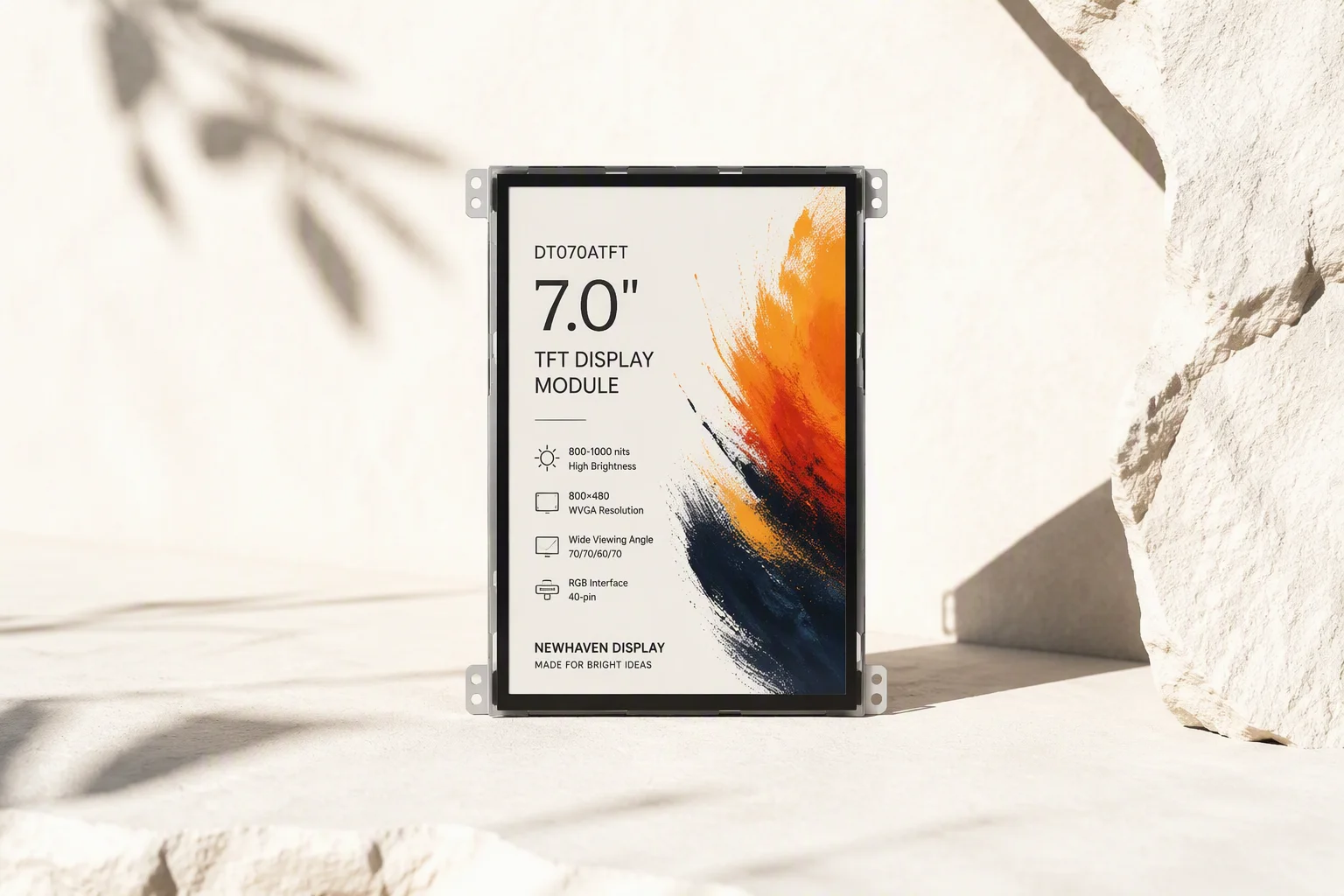
Standard indoor panels run 300–500 nits, which vanishes under ambient light above ~10,000 lux. The step to sunlight readability is a backlight redesign: direct-LED arrays, where LEDs sit behind the light guide in a full grid, deliver 3,000 nits and above, while edge-lit backlights reach roughly 1,000–1,500 nits before the light guide saturates.
Peak versus sustained brightness matters as much as the headline number. A module rated at 5,000 nits peak holds that brightness at a 25°C ambient; at a 45°C enclosure temperature the LED array must be derated, or the driver current reduces to protect LED junction temperature and keep backlight life inside the 20K–70K hour band.
Our high-brightness line ships brightness grades at 500 / 800 / 1,000 / 1,500 / 2,500 / 3,500 / 5,000 nits, each with its own LED count, current target and thermal budget specified on the drawing.
The optical stack: OCA bonding and AR coating
An air gap between the LCD and the cover glass reflects 13–15% of incident sunlight straight back at the viewer. OCA (optically clear adhesive) full lamination fills that gap with a refractive-index-matched layer, cutting reflection to roughly 1–4% — the single biggest readability win after brightness itself.
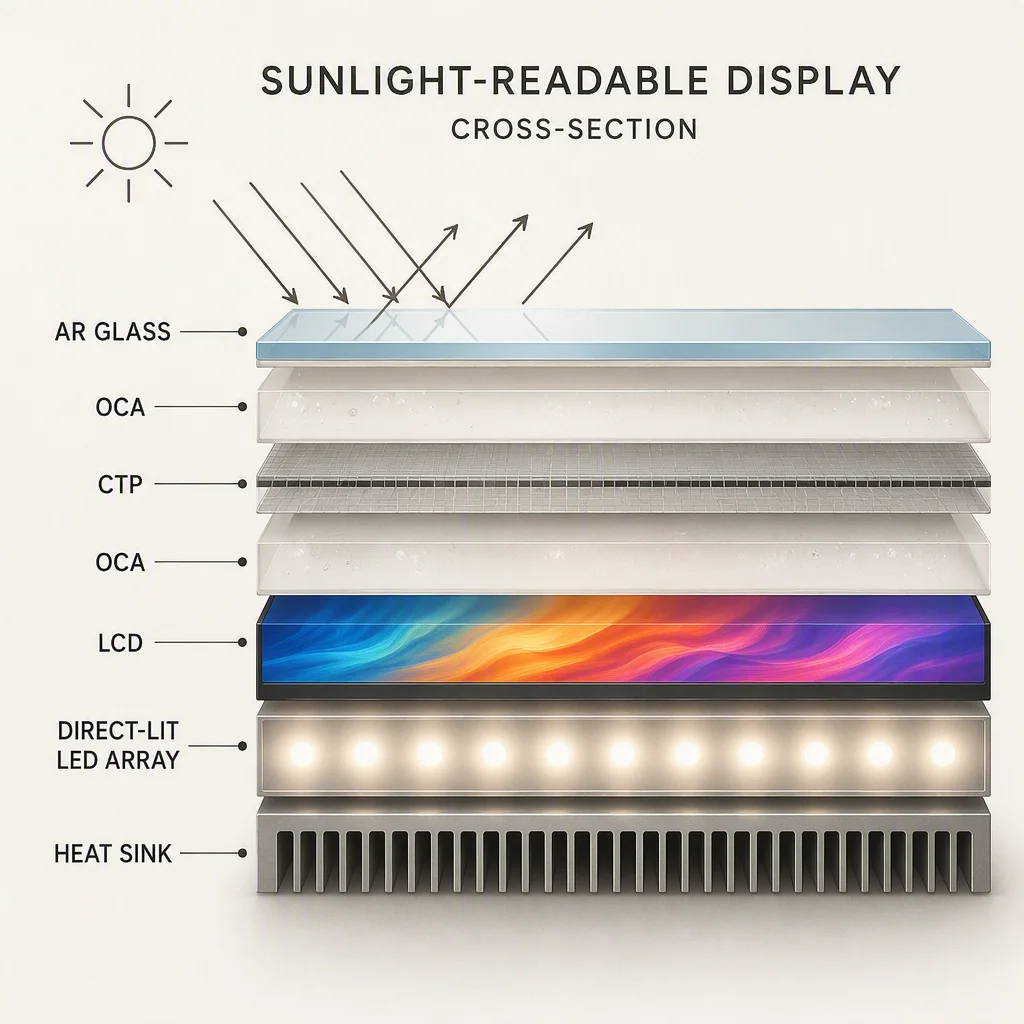
An AR (anti-reflective) coating on the outer glass surface tames specular glare further, and an AG (anti-glare) matte finish is available where the screen sits under direct sky. With touch, the full sunlight-readable stack becomes: AR glass + OCA + CTP + OCA + LCD + direct-lit LED array + heat sink.
- OCA full lamination — reflection 13–15% → 1–4%; also seals dust out of the stack.
- AR coating — cuts specular reflection for fixed-orientation kiosks.
- AG option — matte finish for automotive and moving-angle mounts.
Keeping 5,000 nits from cooking the panel
A direct-LED backlight is a heater as much as a light source. The engineering answer is a metal heat path: the LED board mounts to an aluminum frame that conducts heat to the rear of the enclosure, keeping the touch surface at or below 45°C — the limit users can touch safely and the backlight can run continuously.
Derating is planned, not discovered: at 45°C ambient we reduce sustained brightness to protect LED junction temperature, and we publish both the 25°C and 45°C sustained figures on every high-brightness datasheet so your thermal engineer can size the airflow.
Backlight life closes the loop: LED lifetime in the 20K–70K hour band is measured at junction temperature, and every 10°C above the design point roughly halves the life of the LED array — the reason thermal design is a spec item, not an afterthought.
Enclosure, IP65 and the wide-temperature grade
Outdoor electronics fail at the seal first. The display front assembly is gasketed to IP65/IP66, the operating temperature grade extends to -30~+85°C, and marine variants add salt-fog coating. The table below shows what each design lever buys you, from a standard indoor module to a full outdoor stack.
| Brightness | 300–500 nits standard | 1,000–5,000 nits; direct-LED array ≥3,000 |
|---|---|---|
| Optical bonding | Air gap, 13–15% reflection | OCA full lamination, 1–4% reflection |
| Cover treatment | Bare glass | AR coating, AG matte optional |
| Thermal path | Plastic frame | Aluminum frame, touch surface ≤45°C |
| Sealing | Front bezel | IP65/IP66 gasketed front assembly |
| Temperature grade | -20~+70°C | -30~+85°C wide temperature |
| Typical use | Indoor appliances, POS | Outdoor kiosks, EV charging, signage |
EV charging displays: the sunlight benchmark
Europe has passed one million installed EV charging piles (RisingLCD, 2025), and nearly every one carries an outdoor display that must stay readable at the pump, in direct sun, for a decade of weather. Typical builds run 1,000–2,300 nits with full-lamination CTP — the same stack we ship for kiosk fleets, where one 10.1" 1,500-nit OCA + PCAP program delivered 12,000 units over three quarters.
| Environment | Brightness tier | Design notes |
|---|---|---|
| Covered canopy, semi-outdoor | 1,000–1,500 nits | Edge-lit acceptable; AR coating essential |
| Direct noon sun, fixed mount | 2,500–3,500 nits | Direct-LED array, OCA bonding, thermal frame |
| Extreme all-weather 21.5"+ | 5,000 nits | Direct-LED, active thermal, IP66 |
| Automotive dash, angled sun | 800–1,500 nits | AG + AR, anti-glare cover |
| Marine / navigation | 1,500–3,000 nits | Salt-fog coating, IP66, wide temp |
| EV charging kiosk | 1,000–2,300 nits | Full-lamination CTP, IP65 front |
Take the next step from this article
Continue to the high-brightness capability page for the full parameter envelope, or see how the stack behaves in outdoor and kiosk deployments.
High-Brightness
500–5,000 nits sunlight-readable LCD with optical bonding and AR coating.
IP65 ready ExploreOutdoor Signage
1,000–5,000 nits, IP65/66 sealing and thermal design for signage duty.
24/7 duty View IndustryTFT-LCD Modules
0.96"–15.6" IPS/TN panels, the base technology of every high-brightness build.
800:1 IPS ExploreCustom LCM & ODM
Outdoor stacks quoted to your drawing: brightness, bonding, sealing and thermal.
MOQ from 500 ExploreSend the sun angle and the duty cycle. We'll return the stack that survives it.
Brightness from 1,000 to 5,000 nits, OCA lamination, AR coating, thermal design and IP65 — quoted with samples in 7–15 days and production in 20–35 days, FOB Shenzhen.