Medical device displays aren't like consumer electronics screens. The display on a pulse oximeter, insulin pump, or patient monitor faces a unique set of demands: it must be readable in both dark ICU rooms and bright operating theaters, reliable across temperature extremes, compliant with medical safety standards, and available with guaranteed long-term supply. Choosing between OLED and LCD isn't just about which looks better — it's a system-level decision with implications for power budget, certification, and product lifecycle.
Having supported hundreds of medical device OEMs through display selection, here's our engineering framework for making the right call.
Contrast Ratio: OLED's Unfair Advantage
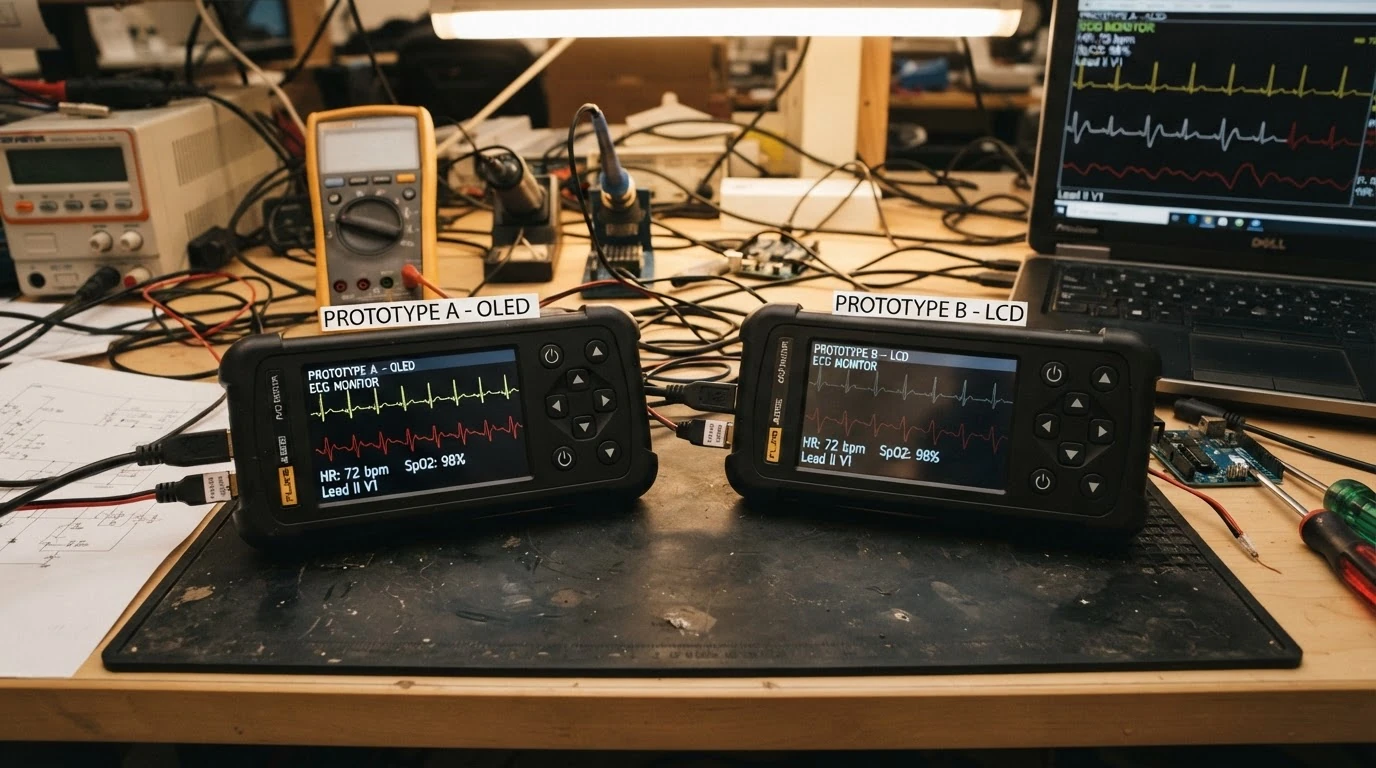
OLED's self-emissive nature means individual pixels can be turned completely off, producing true blacks and an effectively infinite contrast ratio (>10,000:1). LCDs, even high-quality IPS panels, typically achieve 800:1 to 1500:1 — respectable, but limited by the always-on backlight bleeding through the liquid crystal layer.
For medical applications, this matters most in two scenarios: devices used in dim or dark environments (ICU monitors at night, sleep apnea devices) where LCD backlight bleed is visible and distracting, and applications requiring precise grayscale differentiation (diagnostic imaging displays, waveform monitors). In both cases, OLED's per-pixel control provides a meaningful clinical advantage.
However, for devices primarily used in well-lit environments — handheld diagnostic tools used in clinics, patient-facing devices in bright rooms — the contrast advantage of OLED narrows. A good transmissive LCD with sufficient backlight brightness can perform comparably in these conditions.
Power Budget: It's Not as Simple as It Looks
The common wisdom is that OLED consumes less power than LCD. This is true for predominantly dark UI content (dark mode, night-time displays) where most OLED pixels are off. But for predominantly white or bright content — which describes the majority of medical device UIs, with their white backgrounds, waveform traces, and numeric readouts — the equation can actually flip.
An LCD's backlight power is constant regardless of content. A 1.3-inch white OLED displaying a typical 128×64 UI with 30% pixel activation draws about 15-25mA. The same size LCD with always-on white LED backlight draws about 20-30mA total (backlight + logic). The difference is modest for monochrome displays.
The real power win for OLED comes in battery-powered portable devices that spend significant time in sleep mode or displaying minimal information. A pulse oximeter that wakes its display for 10 seconds per reading will see dramatically better battery life with OLED — because LCD backlights must stay on for any visibility, while OLED only powers the active pixels during wake.
Lifetime and Burn-In: The Medical Regulatory Reality
This is where OLED faces its toughest scrutiny in medical applications. OLED materials degrade with use — blue sub-pixels degrade faster than red or green — leading to color shift and burn-in over time. For consumer devices replaced every 2-3 years, this is acceptable. For a medical device with a 7-10 year expected service life, it's a regulatory concern.
Key data points for monochrome OLED (the dominant type in medical handhelds):
- White OLED half-life: 30,000-50,000 hours to half brightness (at typical 50% pixel activation)
- At 24/7 operation: 3.4-5.7 years to half brightness
- At 8 hours/day operation: 10+ years — exceeding most device service lifetimes
- Burn-in risk: Real but manageable. Implement pixel shifting, screen savers, and auto-dimming for static UI elements.
LCD backlight LEDs have a comparable 50,000-hour half-life, but the failure mode is different: a gradual, uniform dimming rather than the non-uniform burn-in that OLED can exhibit. For medical regulatory submissions, uniform degradation is easier to document and predict than non-uniform burn-in patterns.
Temperature Range: OLED's Hidden Strength
OLED's operating temperature range of -40°C to +85°C significantly outperforms standard LCD modules (-20°C to +70°C). For medical devices that must operate in ambulance bays (cold), sterilization chambers (hot), or outdoor emergency scenarios, this extra margin can eliminate the need for display heating elements or active cooling.
LCD response time also degrades dramatically at low temperatures — below -10°C, the liquid crystal fluid becomes viscous, and refresh rates drop from 60Hz to 10Hz or worse. OLED, being solid-state, maintains its <10μs response time across the full temperature range. For medical devices used in cold-chain logistics or emergency field deployment, this can be the deciding factor.
Supply Chain and Longevity
Medical devices require guaranteed availability for 7-10 years. This is where mature LCD technologies (especially monochrome character and graphic LCDs with standardized HD44780 or ST7920 controllers) have a clear advantage: multiple sources, mature fabs, and decades of proven longevity.
OLED supply chains are younger and more concentrated. SSD1306/SH1106-based monochrome OLEDs have been in production for 10+ years and are reasonably stable, but color OLEDs and TFT-grade AMOLEDs have shorter guaranteed availability windows. If your medical device needs a 10-year supply commitment, standardize on monochrome OLED or LCD — avoid exotic resolutions or color variants unless your volumes justify a custom supply agreement.
Regulatory Considerations
IEC 60601-1 (medical electrical equipment safety) applies regardless of display type, but a few display-specific considerations are worth flagging:
- Leakage current: OLED's simpler construction (no high-voltage backlight driver) can simplify leakage current compliance versus CCFL-backlit LCDs. LED-backlit LCDs are comparable to OLED in this regard.
- EMI: OLED driver ICs generate less EMI than LCD backlight boost converters. For devices with sensitive analog front-ends (ECG, EEG), OLED can simplify EMC pre-compliance.
- Flammability: Both technologies use glass substrates and are UL 94 V-0 rated at the module level. No meaningful difference.
Decision Matrix
| Criterion | Monochrome OLED | Monochrome LCD | Color TFT LCD |
|---|---|---|---|
| Contrast | ★★★★★ | ★★★ | ★★★★ |
| Power (dark UI) | ★★★★★ | ★★ | ★★ |
| Lifetime | ★★★ | ★★★★ | ★★★★ |
| Temp Range | ★★★★★ | ★★★ | ★★★ |
| Sunlight Readable | ★★ | ★★ | ★★★ |
| Supply Longevity | ★★★★ | ★★★★★ | ★★★ |
| Cost (10k vol) | $-$$ | $ | $$-$$$ |
| Thickness | ★★★★★ | ★★★ | ★★ |
Our Recommendation
For handheld, battery-powered medical devices with dark UIs: monochrome OLED. The contrast, thinness, and wide temperature range are genuine advantages, and the lifetime concern is manageable with proper drive strategies.
For always-on, mains-powered medical equipment with white-background UIs: LED-backlit monochrome LCD or color TFT LCD. The supply chain maturity and uniform degradation characteristics simplify regulatory documentation.
For outdoor/emergency medical devices: transflective LCD or OLED — depending on whether sunlight readability (LCD) or low-temperature performance (OLED) is the primary concern.
As always, the right answer depends on your specific use case. Our engineering team is available to help you evaluate options with real samples and reliability data. Reach out or browse our medical display product lines.