The Internet of Things has a display problem. Billions of connected devices need to show information — sensor readings, shipment status, pricing, instructions — but traditional LCD and OLED displays consume power continuously, require complex driver electronics, and are often unreadable in the environments where IoT devices actually live: warehouses, factory floors, outdoor installations, and retail shelves.
Enter e-paper. Also known as electronic paper, e-ink, or electrophoretic display (EPD), this technology has quietly moved beyond e-readers and is now the display technology of choice for a rapidly growing segment of industrial IoT applications. Here's why — and what embedded engineers need to know to integrate e-paper successfully.
The Killer Feature: Zero-Power Image Retention
The defining characteristic of e-paper is bistability. Once an image is written to the display, it stays there indefinitely — consuming zero power. The display only draws current during the brief refresh cycle (typically 2-3 seconds for a full refresh, or 300-500ms for a partial update). For a battery-powered IoT sensor that updates its display once per hour, this translates to years of operation on a single coin cell battery.
This fundamentally changes the power budget calculus. A typical 2.9-inch e-paper module draws approximately 8mA at 3.3V during the 2-second refresh — or about 53 millijoules per update. Once updated, power consumption drops to zero. Compare this to an always-on LCD backlight at 50mA continuous, and the energy savings over a device's lifetime are measured in orders of magnitude.
Sunlight-Readable, Wide-Angle, Paper-Like
E-paper is a reflective technology — it works by manipulating the position of charged pigment particles suspended in a clear fluid within microcapsules. Ambient light reflects off the particles, exactly like ink on paper. The result:
- Fully sunlight-readable — the brighter the ambient light, the better the display looks
- Near-180° viewing angle with no color shift or contrast degradation
- Paper-like aesthetic that reads naturally in any orientation
- No blue light emission — easier on the eyes for prolonged viewing
This makes e-paper uniquely suited for environments where LCDs struggle: outdoor kiosks, warehouse shelf labels under bright fluorescent lighting, and logistics tags scanned at awkward angles by forklift operators.
The E-Paper IoT Ecosystem in 2026
The e-paper landscape has matured significantly. Here's what's commercially available and production-ready:
Standard black/white panels from 1.54" to 13.3" are commodity products now, with driver ICs from Solomon Systech (SSD16xx series) and UltraChip (UC81xx series) offering reliable SPI interfaces. Tri-color panels (black/white/red and black/white/yellow) add a second pigment for accent colors — ideal for retail pricing where sale prices need to pop. Partial refresh support has improved dramatically; modern controllers can update small regions without the full-screen flash that characterized early e-paper.
On the MCU side, ESP32, nRF52, and STM32 platforms all have mature driver libraries. The Waveshare and Good Display ecosystems have standardized breakout boards that make prototyping straightforward. What was once exotic is now a standard component in the embedded engineer's toolkit.
Real-World Applications Driving Adoption
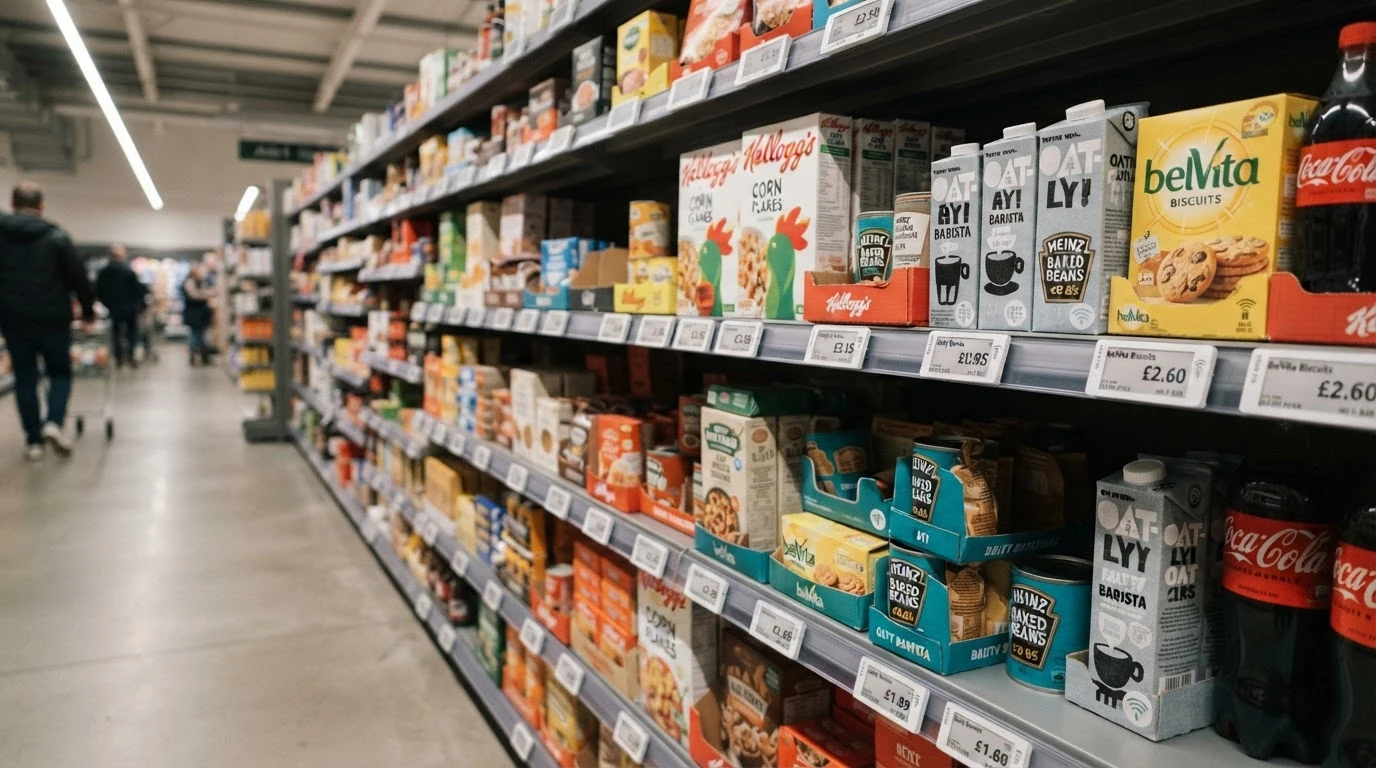
Electronic Shelf Labels (ESL): This is the killer app. Major retailers are converting entire stores to e-paper price tags. A single supermarket might deploy 50,000 labels, each updated wirelessly via 2.4GHz or Sub-GHz mesh networks. The ROI is compelling: eliminate manual price changes, enable dynamic pricing, reduce labor costs. Major ESL deployments now exceed 100 million labels globally.
Cold Chain Monitoring: Temperature loggers for pharmaceutical and food logistics use e-paper to display current temperature, excursion alerts, and remaining shelf life — all readable at a glance without powering up a phone or scanner. The bistable nature means the last-known-good reading is always visible, even if the battery dies.
Smart Building Signage: Room booking displays outside conference rooms, desk occupancy indicators for hot-desking, and wayfinding signs that update based on schedule — all battery-powered and maintenance-free for years.
Industrial Status Indicators: On factory floors, e-paper displays show machine status, production counts, and maintenance alerts. They're visible under high-bay lighting, dust-resistant (no backlight to attract particles), and can be updated from the central MES system.
Integration Considerations for Engineers
E-paper integration isn't without its gotchas. Engineers should plan for:
- Temperature range: Standard e-paper is rated 0°C to +50°C. For cold chain or outdoor applications, specify extended-range panels (-15°C to +65°C). Below freezing, refresh speed degrades significantly.
- Refresh management: Full refreshes (2-3 seconds with visible flashing) are necessary every ~10-20 partial updates to prevent ghosting. Design your UI update strategy accordingly.
- Waveform files: Each panel model requires a specific waveform lookup table (LUT) file loaded into the driver IC. This is handled by most driver libraries, but custom panels may require waveform characterization.
- SPI bus speed: Image data for a 800×480 panel at 1 bit per pixel is about 48KB per frame. At 10MHz SPI, that's ~40ms for data transfer plus 2-3 seconds for the physical refresh. For fast-updating applications, consider the total cycle time.
- Supply voltage: Most e-paper panels require a boosted voltage rail (typically 15-22V) for the driver IC. Modules with integrated boost converters simplify this, but check the spec sheet.
Why We're Bullish on E-Paper
At EMS Display, we've seen e-paper grow from a niche curiosity to one of our fastest-growing product lines. The combination of zero static power, sunlight readability, and maturing infrastructure (both hardware and software) makes it a compelling choice for an expanding range of IoT applications. As the technology continues to improve — faster refresh, better color, wider temperature range — we expect adoption to accelerate further.
If you're designing a connected device that needs to display information, ask yourself: does it really need a backlight? The answer, increasingly, is no.
Need e-paper displays for your IoT project? Browse our e-paper product line or contact our engineering team for a consultation.